At home care, inc.


At home care, inc.

Who Is Eligible for the Aid and Attendance Pension Benefit?
Filing a claim can be time-consuming and complicated. It's important to get help.
Applications for Pension that involve a rating, evidence of prospective, recurring medical expenses, appointments for VA powers of attorney and fiduciaries, and an understanding of the actual application process should not be attempted without prior knowledge. We recommend you purchase our book to avoid lengthy delays in a decision or possible denials of the claim. Not only does the book help you understand how to shorten the decision process from VA and ensure a successful claim but the support forms we provide also help you present medical evidence and costs in a format familiar to VA service representatives. Applications that also involve reallocation of assets in order to qualify should not be attempted without the help of a qualified veterans aid and attendance benefit consultant.
Eligibility Rules for Pension
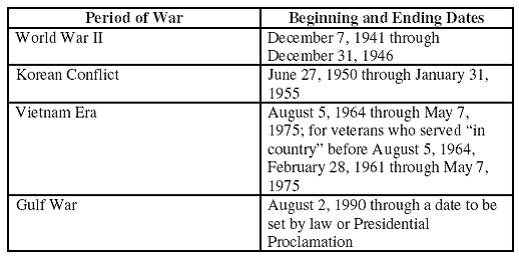
To receive Pension, a veteran must have served on active duty, at least 90 days, during a period of war. There must be an honorable discharge. Single surviving spouses of such veterans are also eligible. If younger than 65, the veteran must be totally disabled. If age 65 and older, there is no requirement for disability. There is no disability requirement for a single surviving spouse.
The veteran household cannot have income -- adjusted for unreimbursed medical expenses -- exceeding the Maximum Allowable Pension Rate-- MAPR -- for that veteran's Pension income category. If the adjusted income exceeds MAPR, there is no benefit. If adjusted income is less than the MAPR, the veteran receives a Pension income that is equal to the difference between MAPR and the household income adjusted for unreimbursed medical expenses. The Pension income is calculated, based on 12 months of future household income, but paid monthly.
The Special Case for Long Term Care Costs
A special provision for calculating Pension income, allows household income to be reduced by 12 months worth of future, recurring medical expenses. Normally, income is only reduced by medical expenses incurred in the month of application. These allowable, annualized medical expenses are such things as insurance premiums, the cost of home care, the cost of paying any person to provide care.
This special provision can allow veteran households earning more than the annual MAPR to qualify for Pension. As an example, a veteran household earning $6,000 a month could still qualify for Pension if the veteran is paying $4,500 to $6,000 a month for nursing home costs. The applicant must submit appropriate evidence for a rating and for recurring costs in order to qualify for this special provision. VA normally does not tell applicants about this special treatment of medical expenses or how to qualify for it. Our book provides ample information on this special treatment and provides appropriate forms to present medical and cost evidence in the most favorable manner.
Dealing with Assets That May Disqualify the Applicant
There is also an asset test to qualify for Pension. Any asset or investment that could be easily converted into income might disqualify the claimant. An asset ceiling of $80,000 is often cited in the media as being the test. The $80,000 has to do with VA internal filing requirements and is not an actual test. In reality, there is no dollar amount for the test and any level of assets could block the award. The asset test ultimately becomes a subjective decision made by the veteran’s service representative, processing the application.
Using Aid and Attendance to Pay Any Person for Care in the Home
Most people who have heard about Pension know that it will cover the costs of assisted living and, in some cases, cover nursing home costs as well. But the majority of those receiving long term care in this country are in their homes. Estimates are that approximately 70% to 80% of all long term care is being provided in the home. All of the information available about Pension overlooks the fact that this benefit should be used to pay for home care. Maybe if more people knew this fact, more people would be applying for the benefit.
It also comes as a surprise to most people that VA will allow veterans’ households to deduct the annual cost of paying any person such as family members, friends or hired help for care when calculating the Pension benefit. This annual cost is then used to calculate the benefit based on a new "countable income" and allows families earning more than the pension benefit to receive a disability income from VA
This extra income can be a welcome benefit for families struggling to provide eldercare for loved ones at home. Under the right circumstances, this annualized medical expense for the cost of family members, friends or any other person providing care, could create an additional household income of up to $999 a month for a single surviving spouse of a veteran, up to $1,555 a month for a single veteran or up to $1,843 a month for a couple.
If the disabled care recipient has been rated "housebound" or in need of "aid and attendance" by VA, all fees paid to an in-home attendant will be allowed as long as the attendant provides some medical or nursing services for the disabled person. The attendant does not have to be a licensed health professional. Services of licensed home care providers can be deducted without any need for a rating but the pension award is a lesser amount.
It is our understanding that a nonlicensed in-home attendant could be just about anyone receiving pay for providing services. This might be members of the family, friends, or someone hired to live in the home. Examples of medical or nursing services would be help with activities of daily living such as dressing, bathing, toileting, ambulating, feeding, diapering and so on. Other services might include medication reminders or supervision necessary to provide a protective environment for the care recipient -- in the case of dementia or Alzheimer's.
All reasonable fees paid to the individual for personal care of the disabled person and maintenance of the disabled person's immediate environment may be allowed. This includes such services as cooking and housecleaning. It is not necessary to distinguish between "medical" and "nonmedical" services. Services which are beyond the scope of personal care of the disabled person and maintenance of the disabled person's immediate environment may not be allowed. This might include paying the bills, providing transportation for other family members, cooking and cleaning for other family members, providing entertainment, providing transportation for personal needs other than medical and so on.
For a disabled person who has been rated, a family member may be considered an in-home attendant, but that family member has to be paid for services duly rendered. There is potential for fraud here where a family member may move into the home and ostensibly receive payment as a caregiver but not actually provide the level of care paid for. Documentation for this care must be provided to VA, and it is reasonable for VA to question whether the services being purchased from a family member living in the household are legitimate. Such arrangements should be extensively documented and completely arm's-length.
The care arrangements and payment must be made prior to application and there must be evidence that this care is needed on an ongoing and regular basis. We recommend a formal care contract and weekly invoice billing for services. Money must exchange hands and there must be evidence of this. All of this documentation must be provided as proof to VA when making application for the pension benefit. Costs for these services must be unreimbursed; meaning these costs are not paid by insurance, by contributions from the family or from other sources.
Let's look at the following example.
If VA allows annualization of the cost of the care contract in calculating the Pension benefit, Michelle's mother should receive an award. In calculating Pension, Michelle's $1,300 a month contract payment should be annualized and subtracted from her annual income. An additional medical deduction is included for Carla's $200 a month payments for Medicare Part B, Medicare Part D and a Medicare supplement policy. This additional amount should be annualized and also subtracted from Carla's income. Both the contract payments and the insurance premiums are adjusted for 5% of MAPR before being subtracted from Carla's income. Her new "countable" income will be negative and subtracting that new income from the MAPR will allow Carla to receive the maximum Pension benefit for her rating category.
Conclusion
Depending on household income and the amount of the care contract and the amount of VA Pension income, these types of care arrangements could be a welcome addition for families struggling to provide care for their loved ones at home. Family care providers, on contract with their loved ones, do not have to be residing in the home. Caution should be exercised that these are indeed legitimate contracts and care provider arrangements and there are no behind-the-scenes transfers of monies.
It is our understanding that a nonlicensed in-home attendant could be just about anyone receiving pay for providing services. This can be someone hired to live in the home. Examples of medical or nursing services would be help with activities of daily living such as dressing, bathing, toileting, ambulating, feeding, diapering and so on. Other services might include medication reminders or supervision necessary to provide a protective environment for the care recipient -- in the case of dementia or Alzheimer's.
All reasonable fees paid to the individual for personal care of the disabled person and maintenance of the disabled person's immediate environment may be allowed. This includes such services as cooking and housecleaning. It is not necessary to distinguish between "medical" and "nonmedical" services. Services which are beyond the scope of personal care of the disabled person and maintenance of the disabled person's immediate environment may not be allowed. This might include paying the bills, providing transportation for other family members, cooking and cleaning for other family members, providing entertainment, providing transportation for personal needs other than medical and so on.
According to 38 CFR Part Three, the following criteria are used to determine the need for aid and attendance:
• Inability of claimant to dress or undress himself (herself), or to keep himself (herself) ordinarily clean and presentable;
• frequent need of adjustment of any special prosthetic or orthopedic appliances which by reason of the particular disability cannot be done without aid (this will not include the adjustment of appliances which normal persons would be unable to adjust without aid, such as supports, belts, lacing at the back, etc.);
• Inability of claimant to feed himself (herself) through loss of coordination of upper extremities or through extreme weakness;
• Inability to attend to the wants of nature;
• Or incapacity, physical or mental, which requires care or assistance on a regular basis to protect the claimant from hazards or dangers incident to his or her daily environment.
